» Archive for the 'books' Category
Reading Gao Minglu, pt. 2 (2008-2010)
[See also: part one of “Reading Gao Minglu,” 1997-2008
请参考:高名潞书目:第一部 (1997-2008年)]
2008 主编《’85美术运动》“The ’85 Movement” (上下卷)[Chinese]
Gao Minglu’s “’85 Movement” gives an inclusive perspective and presents the most moving and utopian, most filled with youthful rebelliousness and broadly germinal movement in contemporary Chinese art history. The book is separated into two volumes, the first, “the avant-garde humanities in the 80s” is an updated version of “A History of Chinese Contemporary Art: 1985-1986,” written by Gao Minglu, Zhou Yan, Shu Qun, Wang Xiaochang, Wang Mingxian, Tong Dian, etc. (published by Shanghai People’s Press, 1991). The second half, “Historical Documents,” is a collection of documents edited by Gao and organized both chronologically and thematically. The two volumes equal more than one thousand pages, with photos and text that mutually enhance each other, the voluminous weight of these books attest to the importance of this history.
Gao Minglu was an active participant and the theoretical bannerman for the ’85 Movement, using “85” as the name of the new wave, it is his intention to echo the May Fourth new culture movement that happened earlier in the century. Therefore, the ’85 Movement is not only a contemporary art movement, but even more is a thought movement, a cultural movement. In Gao’s opinion, the achievements of the ’85 Movement are not the production of a few masters, but is in this trend’s process of development of a lifestyle.
From the perspective of how much time it took to compile this book, it has been twenty years in the making. In between the recollections of eye-witnesses and historians, Gao Minglu’s idealism and consciousness of the common man was consistently there. Idealism endowed historians with a critical perspective, and the consciousness of the common man caused historians to turn their attention from the masters to the “art plebeians.” Gao stresses the “collective” character of the New Wave, and its lack of representative figures. Thus, in the “Historical Documents” section, he preserves such a great amount of artist collectives and movements that might seem insignificant from today’s point of view. However, this is the reality of history. “We don’t regret for the disappearance, not recording the vanished is in fact our shame.” This statement, written by Gao Minglu in the 80s, still affirms his beliefs two decades later.
This publication follows the successive exhibitions of New Wave artists at UCCA and another on the origins of the Stars, but its value is far greater. The art historian Wu Hung has said that this collection of primary sources will eventually lay a foundation for future historians. The artist Xu Bing believes that this book reflects and advocates a kind of complete attitude, an authenticity that Chinese intellectuals are gradually losing. (translation mine)
TOC
’85 Art Movement (volume I): The Enlightenment of Chinese Avant-Garde
Gao Minglu, Forward to the Re-edited Version
Gao Minglu, Forward to the First Edition
Introduction: A History of Contemporary Art as A General Historiography
Chapter I: A General Picture of the Art in the New Period (1976-1984
)
Chapter II: Confronting with ’85 Avant-Garde – Academician Art and Traditional Art in the 1980s
Chapter III: the Wave of Rationalism
Chapter IV: the Current of Life
Chapter V: Transcendence and Return – New Wave Art after ’85 Avant-Garde
Chapter VI: Architecture of the 1980s
Chapter VII: Modern Art and Culture
Chronology of Chinese Contemporary Art: 1977-1989
List of Foreign Names (bilingual)
Gao Minglu: Afterward of the First Edition
Liu Dong: Postscript
’85 Art Movement (volume II): An Anthology of Historical Sources
Gao Minglu, Preface
Chapter I: Non-official Art Societies and Exhibitions after the Cultural Revolution
Chapter II: Summary and Review of ’85 Art Movement
Chapter III: the Wave of Rationalism
Chapter IV: the Current of Life
Chapter V: Conceptual Art, Action and Anti-Art
Chapter VI: Script of TV Documentary “Today’s New Wave Art” (more…)
Posted in books, in translation | 2 Comments »
Reading Gao Minglu: 1997-2008
The following is a complete list of Gao Minglu’s publications in English and Chinese, with synopsis (when available) and table of contents in both English and Chinese, to reveal Chinese language information, click 中文 to your right.
1991 主编《中国当代美术史》editor of “The History of Contemporary Chinese Art” [Chinese only]
Not Available
1997《中国当代美术史(1985—1986)》“The History of Contemporary Chinese Art (1985-1986)” [Chinese only]
TOC
1. A short retrospective––concepts of art in a new era
2. Clues on a movement
3. Tides of rationality
4. The current of life
5. The ’85 New Wave beyond return
6. The choice of traditional or modern
7. Style and plurality
8. Modern art
(translation mine)
TOC
One: New, Old traditions: self-improvement and the collective Utopia
The history and future of Chinese painting (part one)
The background unfolds to Chinese modern art and its development
Discussing Mao Zedong’s Model for Public Art
Two: Post Cultural Revolution: The humanism of Aestheticism and Scars
Painting schools in recent oil painting development
The disillusionment of utopia
The end of a creative era
From Aestheticism to New Academicism
“Style” and “ultra-style”
Three: the Chinese avant-garde as a movement, not a school
Anti-utopian Utopia
Collective and Individual consciousness in contemporary painting
Comparison on three levels
The ’85 Movement
A discussion with Gao Minglu
The status and significance of New Wave art within the structure of Contemporary art in China
On Rational Painting
Avant-garde and humanities––Anti-Utopian Utopia in the ’85 Movement
From art criticism to critical art
The conflicts and challenges of an foreign culture battlefield
Moving towards postmodernism––a letter to Ren Jian
The Chinese cultural battlefield on native soil
Kitsch, Power, Complicity
Four: Avant-garde art and modern consciousness
New Yangwu and New “National Essence” (guocui)
Modern Consciousness and the ’85 Movement
Consciousness of the “cultural vanguard” and the ’85 Movement
Culture and Fine Art, on the margins of fine art and the cultural arts
The spatial function and forms of sculpture
When we are in dialogue, we need to broaden our hearts
All history is contemporary history: contemporary art history as general history
Postscript
“Chinese Avant-Garde Art” published list of articles and titles
(translation mine)
1998 “Inside Out: New Chinese Art” [English only]
Inside Out is the catalog for a groundbreaking exhibition organized by the Asia Society in New York, with venues also in San Francisco, Seattle, and Monterrey, Mexico. It discusses the first major presentation in the West of contemporary Chinese art and is the most important critique of the field to date. As they pursue their personal visions, Chinese artists tread between two extremes: embracing or rejecting their classical tradition. It is not easy for a Chinese artist to break away from such a rich treasury. For example, many works in the show deal with the written word–that most valued of China’s art forms, with its dual connotations of calligraphic beauty and obsessive ritualistic copying. Song Dong writes on a flat stone with water that quickly evaporates; Xu Bing invents witty, new, but meaningless characters. Understanding a work may require acquaintance with the classics: a suspended boat impaled with arrows harks back to a third-century general who sent straw-filled boats down-river to attract hostile fire, retrieved the boats, and collected his enemies’ arrows to use against them. There is an implicit anti-West message here. Other works, including installation, video, and performance art, have universal connotations that owe nothing to Chinese conventions. Contemporary Chinese art has been around for less than 20 years, but the freshness and variety of the work described in this book indicate that an original new force has joined the global art community. (John Stevenson via amazon.com)
TOC
Towards a Transnational Modernity: An overview of Inside Out (Gao Minglu)
Across Trans-Chinese Landscapes: Reflections on Contemporary Chinese Cultures (Leo Ou-Fan Lee)
The Post-Ideological Avant-Garde (Norman Bryson)
Ruins, Fragmentation and the Chinese Modern/Postmodern (Wu Hung)
Beyond The Middle Kingdom: An Insider’s View (Chang Tsong-Zung)
From Elite to Small Man: The Many Faces of a Transitional Avant-Garde in Mainland China (Gao Minglu)
Striving for a Cultural Identity in the Maze of Power Struggles: A Brief Introduction to the development of contemporary art in Taiwan (Victoria Y. Lu)
Found in Transit: Hong Kong Art in a Time of Change (David Clarke)
Strategies of Survival in the Third Space: A Conversation on the Situation of Chinese Artists overseas in the 1990s (Hou Hanru and Gao Minglu)
2001《世纪乌托邦:大陸前衛藝術》(台湾) “Century Utopia: Avant-garde Art on the Mainland” (Taiwan) [Chinese only]
Not Available
2003《中国及多主义》”Chinese Maximalism” [Chinese only]
“Chinese Maximalism” analyzes the characteristics of these “Chinese” “maximalists” through the different angles of contemporary background, Chinese traditional thought and its differences from Western abstract art. The author takes off from specific theories and works, and from the angles of the contextual relationship between the works themselves and their creative contexts, analyze this unique artistic phenomenon and its “significance.” The author points out, Chinese “Maximalist” art is not a personal expression, and neither is it an “abstract” representation of the exterior world, but is an inseparable part of these artists’ artistic philosophy and life philosophy. It is an exploration of the crystallization of an an artistic method that contributes to the fusion of the traditional and contemporary. Until today, “Chinese Maximalism” and extreme repetition, process, quantity and other linguistic forms filled with dismissive criticisms of a semantic fashion. At the same time, art inspired us to think about the establishment of a new contemporary art and the importance of and sense of urgency in artists’ personal awareness. (translation mine)
TOC:
Chinese Maximalism: An Alternative “Metaphysical Art”
An Introduction: The Definition of Maximalism and its Artistic Context
Critiques on the Methodology of Chinese Maximalism
Conclusion: Maximalism is a Methodology to be Shared
Postscripts
Posted in books, in translation | 4 Comments »
An American Art Critic’s Adventures in China
The title alone of Barbara Pollack’s part exposé, part romp through the Chinese art world seems enough to identify the author’s New Yorker status. But she wears her outsider status like a badge, humbly poising herself to profile art world power players and make a broad outline of the yet infantile Chinese art infrastructure. As an American art critic covering contemporary art from China since the late 1990s, but who remains physically and metaphysically rooted in the Western hemisphere, her observations strive to be impartial and critical, as she wields her pen not on Chinese art objects per se, but the people and the institutions that beget them.
Her reporting skills, and relatively guanxi-free status among what can seem like a tiny, and steamy art world in China help her to collect and present enough information to capture the complexity and scratch the surface of this microcosm. She dives into personal impressions of Ai Weiwei with relish and bares her astonishment at dubious museum shows––all in-between Benson & Hedges and ladies’ nights out with one of her gatekeepers to the Chinese art world, the gallerist Meg Maggio.
The Wild, Wild East isn’t quite a Seven Days in the Art World for the Chinese contemporary art scene, but Pollock smartly plays her “foreign journalist” credentials to work her way to the highest echelons of Beijing and Shanghai’s art world power structure. While every “insider” will surely find points to dispute, they are equally sure to take away something new; newcomers or casual readers will find it a highly readable introduction, especially with regard to the art market.
Pollock well knows, the laowai status within China can be a double-edged sword, and many people have obviously worked on maintaining their “face,” never quite withholding information, but surely not “airing their dirty linens” before the foreign journalist. Although she doesn’t address this directly, Pollock’s self-awareness and sensitivity to her dilemma is reflected in divulging portrayals of her translator, Zhang Fang (also the wife of artist Wang Qingsong, whose intermittent commentary was valuable and entertaining).
Approaching this behemoth––the very complex, very foreign rising art world in the East––takes moxie, which this native New Yorker indubitably reflects in her first book. The Wild, Wild East wavers between dish and reportage, and is unquestionably the most ambitious attempt to date at a narrative account of the light-speed developments in Chinese world of contemporary art, in either English or Mandarin.
Barbara will launch her book at the Bookworm on the 22nd, and at Beijing’s UCCA on April 24.
Posted in art, books, newsclips | 3 Comments »
Urban China: Work in Progress
Perhaps artists like to think of themselves as harbingers of social change, at least think they like to imagine themselves on the vanguard of something. In China, they seem more like backseat drivers. However, the world’s fasting urbanizing nation is heaving forward in myriad expressions, and relentlessly posing challenges to the entire globe with a host of issues that will shape the next decade.Urban China is a magazine that has hovered on the fringes of the art world since it was founded four years, it examines various urban issues in themed monthly issues, featuring intellectuals, artists and social scientists writing on topics such as Chinese creativity, education, migration, or Chinatowns. URBAN CHINA: Work in Progress (Timezone8, 2009), is a new publication co-edited by magazine founder Jiang Jun and Brendan McGetrick that seems to reiterate the supremacy of the urban machine over the artist’s ego, as the book itself grew out of a series of questions that emerged from UC’s participation in Documenta 12 (2007). (more…)
Posted in books, in translation, pop culture | No Comments »
“New Generation Artists” and Yin Jinan
Yin Jinan wrote “Knocking on the door alone” as a response to the urgings of many who thought that his position as chair of the Central Academy of Fine Art’s art history department and as a “close-up” observer, warranted a publication. The second book “Post-motherism” (will follow in separate review) is a compilation of years of art criticism published in his column in duzhe magazine 《读者》also entitled “knocking”, duzikoumen “独自叩门”. The implied meaning of this title is: when we look at art we are always seeking a personal interpretation, and our individual experiences inform our reading.
The essays range from 1988, in an essay on the joint exhibition of Lu Shengzhong and Xu Bing at the National Museum of Art, “新潮美术的转折点” (The turning point of the New Wave), to 1992 (in dialogue with Sui Jianguo). Yin’s connections with art are very influenced by his proximity to the art academy, and to many artists who were making important names, such as Liu Xiaodong and Yu Hong, Wang Guangyi, Huang Yongping, Sun Xinping and a host of other young painters whom he calls the “New Generation Painters.” These were the emerging generation of artists who were establishing a new POV, moving away from the collectivism of the 1970s and 1980s and depicting personal experiences. Yin’s style is clear and dry, funny at times but aggressively confident when critical.
The book also includes ample writing on Xu Bing, the outrageously well-attended first nude oil painting exhibition in early 1989, and writings on the China / Avantgarde exhibition in 1989, on Chinese modernism and more. Posted below is an essay from this book on “New Generation Artists”, it was translated for a forthcoming publication on Chinese contemporary art from the Museum of Modern Art. To read Chinese version, please switch languages on the upper right hand.
NEW GENERATION AND CLOSE UP ARTISTS
Yin Jinan
Modern Chinese art in the early Nineties is endowed with a certain temporal significance. In the moment when our historical imagination collides with actual landscapes, anyone is able to intuitively identify the fundamental elements belonging to the scope of art history. The literary world’s “age of prose” is precisely coincident with the art world’s period of realism without an artistic manifesto, and settling into their peaceful lifestyles, these artists have created an enormous cultural rift from the maddening infatuation with the explosive and dysphoric concepts that before them. This re-examination and questioning of traditional artistic values and art of the New Wave firstly did not arise from within the theoretical world, but from the creative one. A few stirring solo and group art exhibitions that took place in 1990 and 1991 silently expressed a very confident artistic attitude, a group of young artists born in the 1960s thus emerged onto the scene.
Posted in books, in translation | 7 Comments »
China Museums: At Long Last
CHINA: MUSEUMS
Scala, 384 pages, Feb 2009
Miriam Clifford, Cathy Giangrande and Antony White, all with backgrounds in art history and archeology, have reportedly spent four years combing through China’s hundreds of museums in a search for the most appealing. The result is this in-depth guide to China’s museums that opens up new territories for English-speaking audiences, presumably Western travelers, but for that special, more adventuresome set interested in witnessing China’s cultural growth from a multifaceted perspective. “China: Museums” includes major players, such as the Forbidden City, as well as Chinese equivalents of what could be called “Roadside museums.” Imagine the Squished Penny Museum of Washington DC, translate that into the Beijing Tap Water Museum for an idea of the scale of the many museums referenced here; but then again, our authors have carefully weeded through the deep waters of China’s bowuguan (“museum,” a term that could also be literally broken down to mean an “establishment of ample objects”) to bring us the very best, most socially relevant and worthy selection of China’s ancient memorials, monuments and culturally revealing sites. They prove that lurking behind the Chinglish placards of hundreds of museums across China, there is much to be learned.
With site culled through our authors’ trained, and scrutinizing eyes, “China Museums” is not only a portrait of a nation’s burgeoning museum culture, but a sketchy outline of the earnest efforts of China’s curators or enthusiasts, and a semblance of an infrastructure where we might have assumed there was none. Of course, many Western readers cannot help but judge on appearances when confronted with the widespread curatorial practices Xerox copies glued to walls, or shabby facades and dust-laden velvet curtains, even the sci-fi inspired architecture of modern China can be a turn off. (more…)
Posted in art, books | 2 Comments »
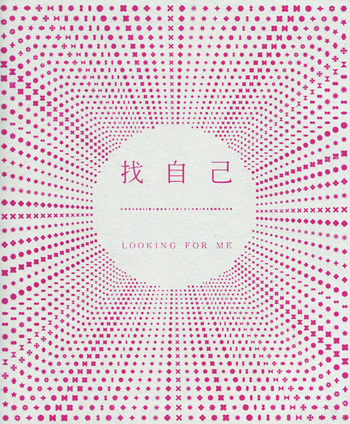
Looking For Me: FOUND
Some of us look forever, others never seek––perhaps they’re already found “ME.” New September 2008 publication
These artists included are among the most outstanding of their generation, they represent Mainland China’s up-and-coming talent in the visual arts. Although often called the “Post 70s” generation, the artists here are mostly born after 1975. The book is a compliment to the exhibition of the same name, curated by Fang Fang (art director of Star Gallery and 2006 exhibition “Naughty Kids”), but is meant to stand on its own, and become a resource tool for those interested in this younger generation of artists, a browsing book.
If you’re like everyone else I know, you’re thinking: What does the name mean?
After spending a summer on this book, researching these artists, writing texts, translating and pondering the very same question I can only say: It means what ever you want it to. Whatever looking for you might entail. May you find it within!
Artists: Ouyang Chun / Li Jikai / Wei Jia / Qin Qi / Huang Yuxing / Xiong Yu / Wen Ling / Wang Guangle / Liu Ding / Li Hui / Qiu Jiongjiong / Song Kun / Wang Yaqiang / Liang Yuanwei / Cao Fei / Wang Yifan / Li Chaoxiong / Chen Ke / Xu Maomao / Jia Aili / Gao Yu / Li Qing / Qiu Xin / Wen Chuan / Yan Cong / Ha Migua / Chen Fei / Jin Nv / unmask
Book design: Liu Zhizhi MEWE
Authors: Lee Ambrozy / Jing Xiaomeng / Gong Jian / Huang Shan / Helen Li / Pauline J Yao / Chang Chang
Posted in Post 70s / 80s art, art, books | 1 Comment »
“Socialism is Great!”

“Socialism is Great” is a coming-of-age tale to be sure, but also a good example of memoir writing from an exceptional person living through some extraordinary times. “Socialism is Great” tells of things great and small: a girl becoming a woman and China shedding its socialist shell. It opens doors on a frugal family and its persistence in life, and the gates of the state-owned factory class as it plods to extinction. Along the way are lovable and despicable characters, all drawn to–or repelled by–our heroine Lijia as she careens through her own mind, trying as she must to keep her ambitions and lust contained behind “the strangest pair [of glasses she] could find in town.”
“Socialism is Great” is a fast read, is passionate and hopeful. Happily, unlike many other memoirs from China it doesn’t end with an escape abroad. In this sense, it captures the spirit of the 80s, as the heroine’s forward momentum brings readers to new depths and acts of bravery, she brings to life a whole new side of China, all without wallowing in self-pity. As she matures, she comes into mature experiences that make this book inappropriate for young audiences, but which definitely left me surprised at the depth of emotion of factory workers and “simple” laborers all.
All in all, this is a new voice to enrich the canon of memoirs from China, it marks the advancement away from the reminiscing over the cultural revolution, and represents one among China’s newest generation of international, accomplished writers.
Book Talk: “Socialism Is Great!” by Zhang LijiaWed June 18, 19:30-21:00
Venue: CCC Learning Centre, Chinese Culture Club, Anjialou, No.29, Liangmaqiao Road, Chaoyang District.
Price: RMB 20 (symbolic charge for drinks and snack) (more…)
Posted in books, pop culture | No Comments »
3030 New Graphic Design in China

Posted in books, design | No Comments »
Naughty Kids

Naughty Kids collects the voices of a rising new generation of Chinese artists in one bulky, unique concept album. Don’t mistake this younger group of artists as deviants; they have already distinguished themselves as the most promising creative force for China’s step into the global arena. But in the midst of China’s ever-changing contemporary art scene these “kids” are adapting some curious themes: see their characteristic cartoon elements manifest in various forms, from enormous, almost 3-D canvases, to pithy notebook doodles. Naughty Kids looks into each artist’s personal nature with pop culture oriented surveys, revealing how much closer this “Post ’70s,” or “consumer generation” of artists is to Western consciousness then we had previously guessed. The design is the creation of Naughty Kid artists’ contemporary, classmate and award-winning designer, Liu Zhizhi. Its edgy concept design is teasing – definitely rascally – and promises to make each copy a smudgy, unique original.
I know, this book is old, but it is still a classic in its time, it pinpoints Post 70s/80s artists before they were even a concept. Looking forward to the next such title from curator Fang Fang: “Looking for Me”
Posted in art, books | No Comments »
China Art Book
Editors Uta GROSENICK and Caspar SCHUBBE
MERRELL publisher,
Available at Timezone 8, 420 RMB
Wherever art works are exchanging hands for millions of dollars, the publishing industry will follow––foolproof publishing logic. Thus China Art Book was born, and is the broadest survey of Chinese artists to date, including 80 attention-grabbing contemporary artists. Although introductions are brief, they are included in German, English, and Chinese… suggesting that this is not reading for merely potential collectors, but hobbyists, and perhaps artists themselves, in these ways it sets a standard in publishing on the field. The book is filled with colour images for each artist and soft bound, it was edited by acclaimed Art Now editor Uta Grosenick and her Beijing counterpart Carol Lu (Lu Yinghua), the team recruited local curators to vote on artists included and contribute to introductory texts––a democratic process¬ no doubt. Why, then, did the book inspire such a confrontational and suspicious crowd at its launch last month at its Beijing launch? Despite the many reasons, Uta hinted at a second edition . . .
originally published in Urbane, February 2008
Posted in books | 1 Comment »